

Immersive Education in Action: Demonstration of AR/VR Scenarios Based on Russian Fairy Tales and Epic Legends at Peter the Great Gymnasium
-
MainMain
-
Press - centerPress - center
-
Immersive Education in Action
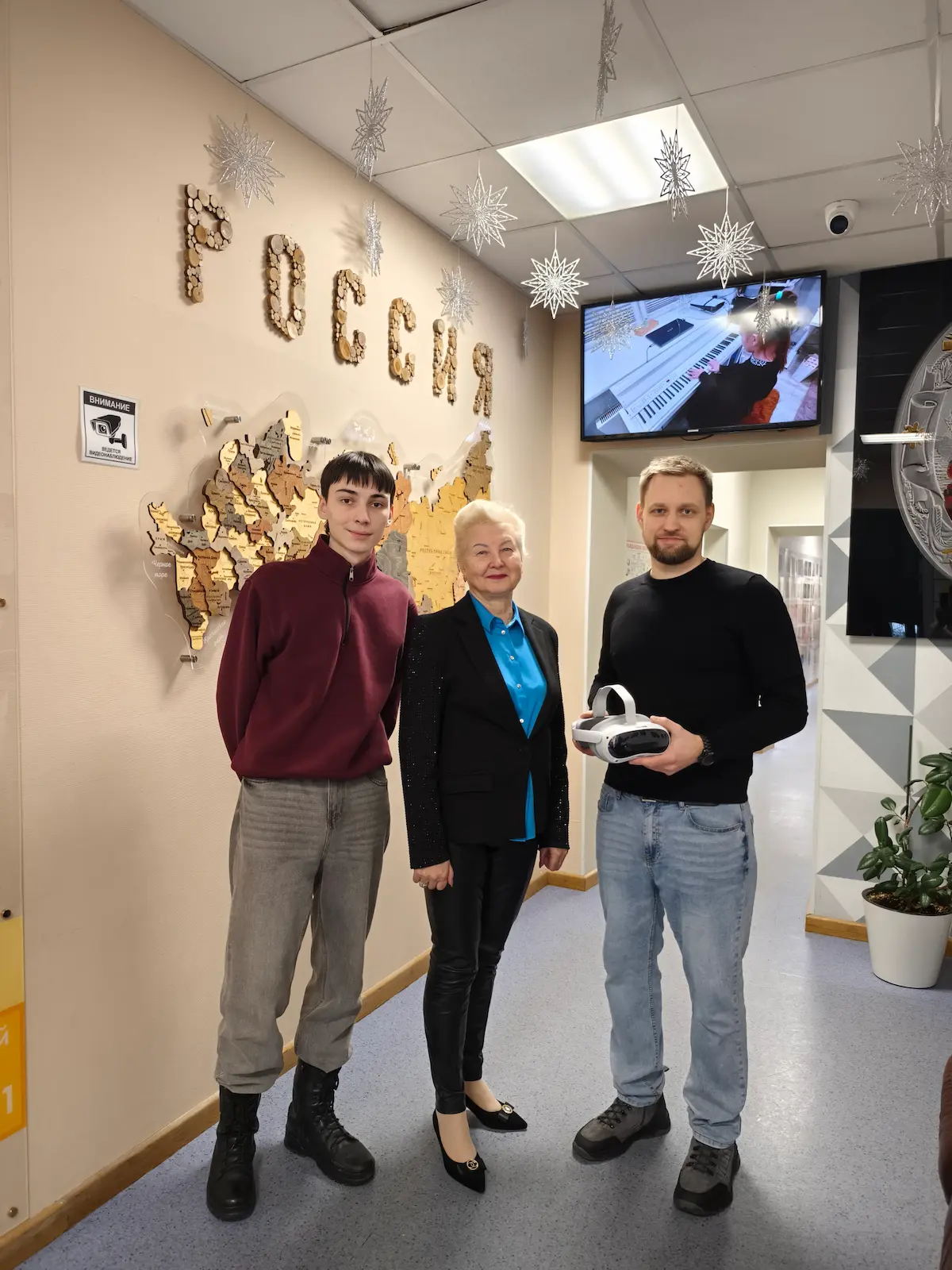
On February 6, in the city of Mytishchi, at the premises of Peter the Great Gymnasium, our company conducted a pilot demonstration of immersive educational AR/VR scenarios for primary school students. The event was held as a test showcase, allowing children and teachers to experience firsthand the capabilities of augmented and virtual reality technologies in the learning process.
During the demonstration, students were immersed in interactive scenarios:
- based on the fairy tales of Alexander Pushkin (“At Lukomorye”)
- “Planetarium”
The format was specifically adapted for primary school age: short sessions, intuitive navigation, game-based tasks, and full immersion without overload or aggressive content. The educational immersive AR/VR quest format enables children to reinforce knowledge gained during traditional classroom lessons. In this way, modern technologies—familiar and engaging for today’s children—complement the educational process.
Feedback from Students and Teachers
The results of the immersive AR/VR demonstration showed a high level of engagement:
- children actively participated in the scenarios, navigated the virtual environment with ease, and completed tasks with great interest;
- attention was sustained throughout the entire session;
- teachers noted that this format naturally complements the core curriculum, helping students consolidate knowledge in a familiar and engaging way.
Particular emphasis was placed on the value of immersive scenarios as a supplementary teaching tool rather than a replacement for traditional classroom instruction: technology serves to enhance learning outcomes and student motivation.
Learning Through Experience, Not Just Texts
Immersive AR/VR scenarios transform topics from textbooks in literature, environmental studies, history, mathematics, Russian language, and social studies into a child’s personal emotional experience. A student does not merely listen or read — they become an active participant in the storyline, interact with characters, make decisions, and retain knowledge at the level of lived experience.
This approach:
- increases interest in learning;
- helps students better understand complex topics;
- develops imagination, attention, and logical thinking;
- forms a strong connection between knowledge and cultural context.
Implementation Prospectsts
Following the event, the format was recognized as highly promising for:
- primary education (as a supplement to the core curriculum);
- extracurricular educational programs;
- cultural and educational projects for children;
- off-site and thematic school activities.
The project is considered a scalable solution that can be integrated into school educational environments and used by teachers as a modern, safe, and methodologically sound instructional tool.